Have you ever ordered a beautiful dress online, waited excitedly for it to arrive, and then realized it does not fit at all? You are not alone. Almost every woman has faced this frustrating moment. One brand says you are a size 6, another brand says you are a size 10, and a UK website says you are a size 12. It feels confusing, and honestly, it can make you doubt your own body.
The truth is, your body is not the problem. The sizing system is the problem.
Women’s dress sizing is not standardized across the world. A US size 8 is not the same as a UK size 8. An EU size 40 sounds completely different, but it might be exactly your size. Add different brands, different fabrics, and different fits like slim, relaxed, or oversized, and it becomes even more confusing.
That is exactly why this guide exists. In this complete US Women’s Dress Size Chart, we will help you find your perfect dress size in just 2 minutes. You will learn how to measure your bust, waist, and hips correctly, how to convert US to UK and EU sizes without any guesswork, and how to avoid the most common mistakes that lead to returns.
By the end of this article, you will never have to guess your dress size again.
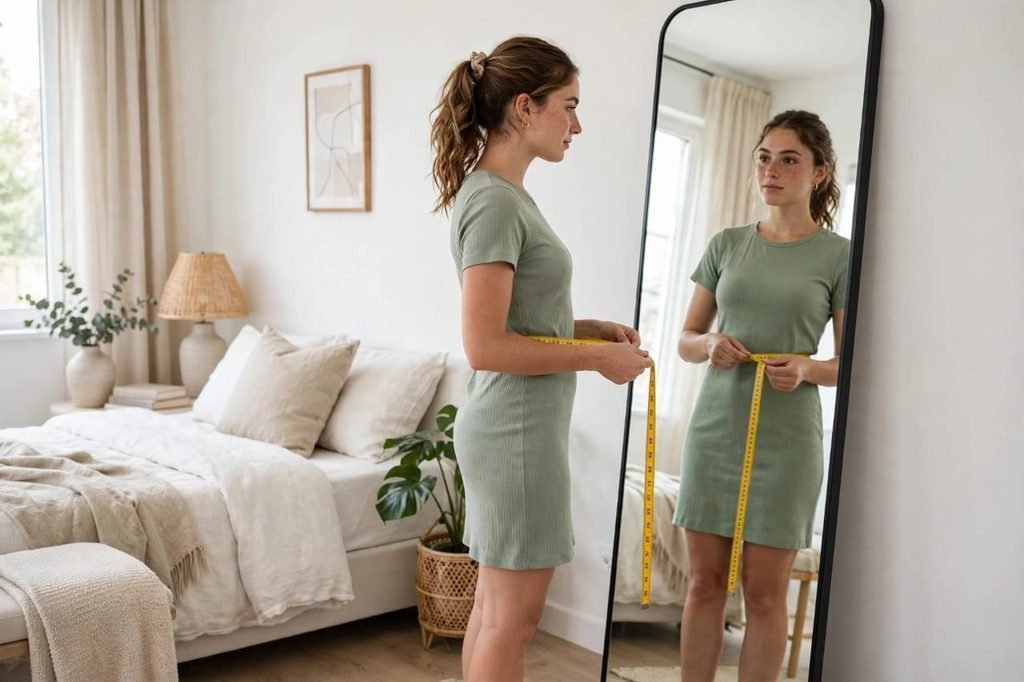
Table of Contents
What Is A Women’s Dress Size, Really?
A dress size is not a measurement of your beauty or your worth. It is simply a number that brands use to group body measurements together.
In the United States, women’s dress sizes usually run from 0 to 20, and sometimes even higher for plus sizes. In the UK, the numbers are 4 higher. In Europe, the numbers look totally different, like 34, 36, 38, 40, 42.
For example: If you wear a US size 8, you will usually wear a UK size 12 and an EU size 40. Same body, three different numbers.
This is why so many women get confused when shopping from international websites like ASOS, Zara, H&M, or Shein. They see a number they have never worn before and panic.
The key is to stop shopping by the number on the label. Start shopping by your actual body measurements. Once you know your bust, waist, and hip measurements in inches or centimeters, you can buy from any country, any brand, and any website with confidence.
Why Dress Sizes Are So Confusing For Women
Let us be honest. Women’s sizing can feel unfair sometimes.
A woman can try on three dresses in the same store, all labeled size 8, and all three will fit differently. One will be too tight at the waist, one will be loose at the bust, and one will fit perfectly. How is that possible?
Here are the real reasons:
1. No Universal Standard
Unlike men’s sizes, which are often based on actual inches, women’s sizes are based on a system that was created more than 70 years ago and has changed many times since. Each brand is free to create its own version of a size 8.
2. Vanity Sizing
Many brands make their sizes smaller on the label to make customers feel good. A dress that was a size 12 in 1990 might be labeled a size 8 today, even though the measurements are the same. This is good for marketing, but bad for shoppers.
3. Different Fits
A bodycon dress, a wrap dress, an A-line dress, and a maxi dress will all fit differently even if they are the same size. The fabric matters too. A stretchy dress will forgive 1 to 2 inches, while a stiff cotton dress will not.
4. Country Differences
The US, UK, and EU all use different numbering. Many women do not know this and order the wrong size from an international site.
That is why a reliable size chart and a correct measurement are more important than ever.
How To Measure Yourself Correctly At Home
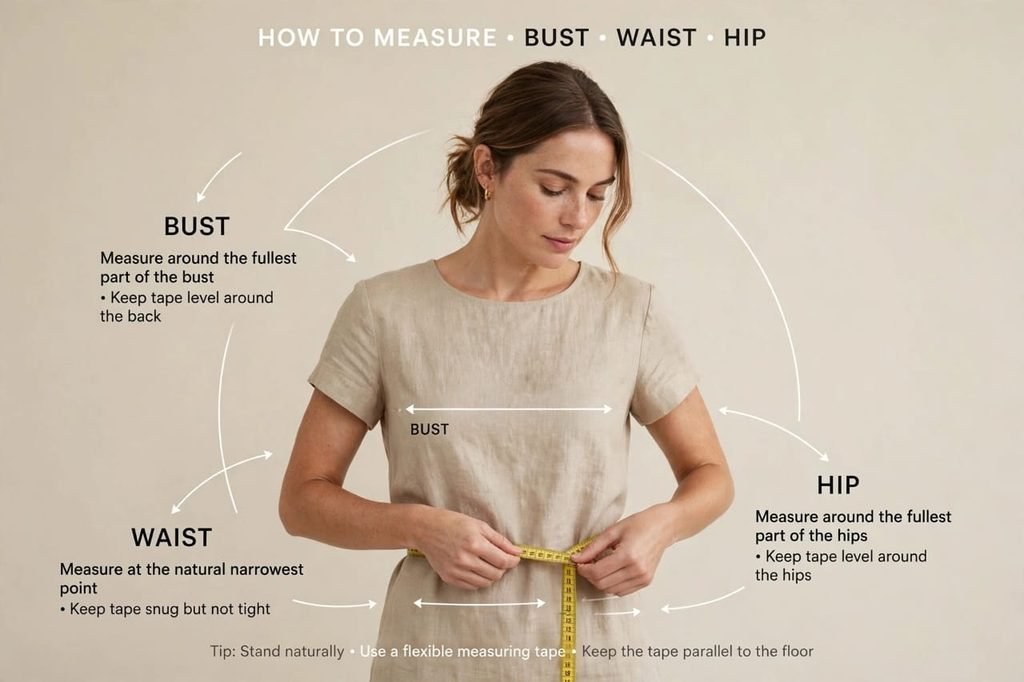
You do not need a tailor. You just need a soft measuring tape, a mirror, and 2 minutes. Wear thin clothes or light underwear for the most accurate result. Stand straight, breathe normally, and do not suck in your stomach. The tape should be snug but not tight. It should sit flat against your body without digging in.
Here is the correct way to take the three most important measurements:
1. Bust Measurement
Wrap the tape around the fullest part of your bust, usually across the nipples. Keep the tape level all the way around your back. Do not pull it too tight. Your arms should be relaxed at your sides. Write down the number in inches.
Pro Tip: Wear the bra you would normally wear with a dress. A padded bra can add 1 inch and change your size.
2. Waist Measurement
This is where most women make a mistake. Your waist is not where your jeans sit. Your natural waist is the narrowest part of your torso, usually about 1 inch above your belly button. Bend slightly to one side, the crease that forms is your natural waist. Wrap the tape around that point and keep it level.
Do not hold your breath. Breathe out normally and then measure.
3. Hip Measurement
Stand with your feet together. Wrap the tape around the fullest part of your hips and buttocks. This is usually about 7 to 8 inches below your natural waist. Make sure the tape is level and not twisted.
Once you have these three numbers, you are ready. These three numbers are your real size. The label is just a translation.
Complete US Women’s Dress Size Chart
This is the standard chart used by most US brands. Use your bust, waist, and hip measurements to find your size. If you are between two sizes, always check the fabric. For stretchy fabric, go down. For non-stretchy fabric, go up.
US Size 0: Bust 31 inches, Waist 24 inches, Hip 33 inches, EU 30, UK 4
US Size 2: Bust 32.5 inches, Waist 25.5 inches, Hip 34.5 inches, EU 32, UK 6
US Size 4: Bust 34 inches, Waist 27 inches, Hip 36 inches, EU 34, UK 8
US Size 6: Bust 35.5 inches, Waist 28.5 inches, Hip 37.5 inches, EU 36, UK 10
US Size 8: Bust 37 inches, Waist 30 inches, Hip 39 inches, EU 38, UK 12
US Size 10: Bust 38.5 inches, Waist 31.5 inches, Hip 40.5 inches, EU 40, UK 14
US Size 12: Bust 40 inches, Waist 33 inches, Hip 42 inches, EU 42, UK 16
US Size 14: Bust 42 inches, Waist 34.5 inches, Hip 44 inches, EU 44, UK 18
US Size 16: Bust 44 inches, Waist 36.5 inches, Hip 46 inches, EU 46, UK 20
US Size 18: Bust 46.5 inches, Waist 39 inches, Hip 48.5 inches, EU 48, UK 22
US Size 20: Bust 48.5 inches, Waist 41 inches, Hip 50.5 inches, EU 50, UK 24
If your bust says size 8 but your hips say size 10, you are not strange. Most women have different sizes on top and bottom. In that case, choose the size based on the most fitted part of the dress. For a fitted pencil dress, follow your hip measurement. For a fitted top dress, follow your bust measurement.
US To UK Dress Size Converter – The Simple Rule
The US to UK conversion is very easy once you know the trick.
UK Size = US Size + 4
That is it.
Examples:
US 2 = UK 6
US 6 = UK 10
US 8 = UK 12
US 10 = UK 14
US 12 = UK 16
So if you are shopping on a UK website like ASOS UK or Next, and you normally wear US 8, do not order UK 8. You will get a dress that is two sizes too small. You need to order UK 12.
The opposite is also true. If you wear UK 12 and you are shopping on a US site like Amazon US or Nordstrom, you need to order US 8.
Many returns happen just because of this one mistake.
US To EU Dress Size Converter – The Complete Chart
European sizes look scary at first, but they are actually very logical. They are roughly your US size plus 30 or 32, depending on the brand.
The most common conversion is:
US 0 = EU 30
US 2 = EU 32
US 4 = EU 34
US 6 = EU 36
US 8 = EU 38
US 10 = EU 40
US 12 = EU 42
US 14 = EU 44
US 16 = EU 46
US 18 = EU 48
US 20 = EU 50
So if you are shopping from Zara, Mango, or H&M Europe, and your US size is 10, look for EU 40.
A quick tip for EU shopping: EU brands often run slightly smaller than US brands. If you are between sizes, it is usually safer to go one size up in EU brands, especially for structured dresses with no stretch.
What About XS, S, M, L, XL Sizes?
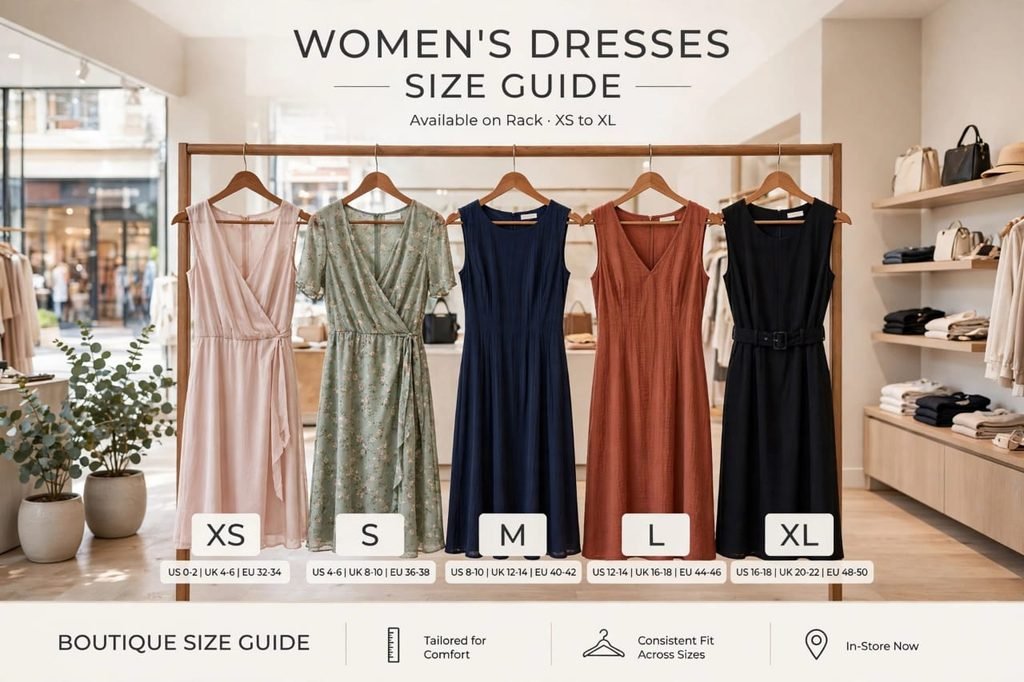
Many casual dresses do not use numbers. They use letters like XS, S, M, L, XL. This can be even more confusing because one brand’s Medium is another brand’s Large.
Here is a general guide that works for most brands:
XS = US 0-2, UK 4-6, EU 32-34
S = US 4-6, UK 8-10, EU 36-38
M = US 8-10, UK 12-14, EU 40-42
L = US 12-14, UK 16-18, EU 44-46
XL = US 16-18, UK 20-22, EU 48-50
XXL = US 20-22, UK 24-26, EU 52-54
If you are shopping for a loose, flowy dress, letter sizing is fine. But if you are shopping for a fitted dress, a wedding dress, or a formal dress, always use the number size with bust, waist, and hip measurements. Letter sizes are too vague for an important dress.
Dress Size By Body Shape – What Actually Works
Your body shape matters more than your size number. Two women can both be size 10 but look completely different in the same dress.
Here is what works for common body shapes:
Hourglass Shape: Your bust and hips are similar, and your waist is much smaller. Wrap dresses, fit-and-flare dresses, and bodycon dresses look beautiful on you because they show your waist.
Pear Shape: Your hips are wider than your bust. A-line dresses, fit-and-flare dresses, and dresses with details on the top will balance your shape. Avoid tight pencil dresses if you do not want attention on your hips.
Apple Shape: You carry more weight around your middle. Empire waist dresses, wrap dresses, and V-neck dresses help create a longer, slimmer look. Avoid very tight fabric around the stomach.
Rectangle Shape: Your bust, waist, and hips are similar. You can create curves with belted dresses, peplum dresses, and ruffled dresses. A dress with a defined waist will help.
Petite Women: If you are under 5’4″, look for petite collections. A regular dress may be too long in the torso and the hem. Petite does not mean small, it means shorter proportions.
Tall Women: If you are over 5’8″, look for tall collections. A regular dress may be too short and the waist may sit too high.
The dress that fits your shape will always look more expensive than a dress that is just the right number.
The Positive Side Of Using A Size Chart
Using a size chart and measuring yourself has many real benefits:
You save money. You avoid paying return shipping and restocking fees again and again.
You save time. You do not have to wait 2 weeks, try it, return it, and wait another 2 weeks.
You feel more confident. When a dress fits correctly, you stand taller and feel better. It is not about being thin, it is about being comfortable.
You can shop internationally. Once you know your EU and UK size, the whole world opens up for shopping. You are not limited to US stores.
You can buy gifts easily. If you know your sister’s or friend’s measurements, you can buy her a dress without asking her size and ruining the surprise.
In short, 2 minutes of measuring can save you hours of frustration.
The Negative Side – What Size Charts Cannot Fix
Now let us be honest. A size chart is not magic. It has limitations, and you should know them.
First, brands do not follow charts perfectly. A size 8 at Shein is not the same as a size 8 at Ralph Lauren. Even with a chart, you still need to check the specific brand’s chart on their product page.
Second, fabric changes everything. A 100% cotton dress with no stretch will fit very differently than a polyester-spandex dress, even if the chart says they are the same size. Always read the fabric composition.
Third, your body changes. Your size can change with weight gain, weight loss, pregnancy, or even your menstrual cycle. A size you wore last year may not be your size today, and that is completely normal. Re-measure every 6 months.
Fourth, charts cannot tell you about style. A chart can tell you a size 10 will fit, but it cannot tell you if a puff sleeve will suit you or if a high neck will make you look shorter. You still need to try different styles.
So use the chart as your best starting point, not as a final guarantee. Always check the return policy before you buy.
7 Common Mistakes Women Make When Choosing Dress Size
1. Guessing Instead Of Measuring: Many women order the size they wore in high school. Your body changes. Measure now.
2. Using Pant Size As Dress Size: Your jeans size is not your dress size. They are measured completely differently.
3. Measuring Over Thick Clothes: A thick sweater can add 2 inches. Always measure over thin clothes.
4. Pulling The Tape Too Tight: If you pull it tight, you will order a dress that is too small and uncomfortable. Keep it snug but comfortable.
5. Ignoring The Brand Chart: The generic chart in this article is a great guide, but the brand’s own chart is even better. Always check both.
6. Ordering One Size For All Dresses: A maxi dress and a bodycon dress need different fits. Do not order the same size blindly for both.
7. Not Checking Reviews: Reviews often say, runs small, order one size up, or runs large. This is free advice from real buyers. Read at least 5 reviews before ordering.
If you avoid these 7 mistakes, your return rate will drop dramatically.
How To Convert Dress Size For Online Shopping – Step By Step
Let us make this super simple for your next order:
Step 1: Measure your bust, waist, and hip today. Write them down on your phone.
Step 2: Find your US size from the chart above using your largest measurement.
Step 3: If the website is UK, add 4 to your US size. If the website is EU, use the EU chart.
Step 4: Check the brand’s own size chart on the product page. If it is different from our chart, trust the brand’s chart.
Step 5: Read the fabric. If it says 95% cotton, 5% spandex, it has a little stretch. If it says 100% polyester with no stretch, consider going up one size.
Step 6: Read 5 reviews. If 3 people say it runs small, order one size up.
Step 7: Check the return policy. Only buy if you can return or exchange easily.
Follow this process and you will get it right 9 out of 10 times.
What Size Should I Order If I Am Between Sizes?
This is the most asked question, and the answer depends on the dress.
If the dress is stretchy, flowy, or oversized, order the smaller size. It will still be comfortable.
If the dress is fitted, structured, formal, or has no stretch, order the larger size. You can always get a dress taken in by a tailor for 10 to 15 dollars, but you cannot make a too-small dress bigger.
If the dress is a wrap dress, you can usually order either size because you can adjust the tie.
When in doubt, size up for comfort. A slightly loose dress looks elegant. A too-tight dress looks uncomfortable and can damage the zipper.
Dress Size For Special Occasions – Wedding, Party, And Formal
For special dresses, do not rely only on the chart. Here is what to do:
For wedding guest dresses, order your normal size but check the length. Long dresses often need hemming.
For bridesmaid dresses, order 2 to 3 months early. These dresses are often made to order and cannot be returned easily. Get professionally measured at a bridal shop.
For prom dresses, check if the dress has a built-in bra or boning. These dresses run smaller. You may need to go up one size.
For maternity dresses, do not order your pre-pregnancy size. Look for maternity size charts which are based on your pre-pregnancy size plus room for the bump.
For work dresses, comfort matters more than a perfect fit. If you sit all day, a slightly looser dress will be much more comfortable.
Frequently Asked Questions
What is my dress size if my bust is 36, waist 29, and hip 38?
You are most likely a US size 8, UK size 12, EU size 38. Your hip is your largest measurement, so follow that.
Is a US size 8 the same as a UK size 8?
No. A US size 8 equals a UK size 12. A UK size 8 equals a US size 4. Always add 4 when going from US to UK.
What is EU size 40 in US?
EU 40 is usually US 10 and UK 14. This is one of the most common sizes in Europe.
What size is a Medium in women’s dresses?
A Medium is usually US 8 to 10, UK 12 to 14, EU 40 to 42. But it varies by brand, so check the chart.
How do I know my dress size without measuring?
You can check the size of a dress that already fits you well and look at its label. But measuring is always more accurate.
Do dress sizes differ by brand?
Yes, a lot. Always check the brand’s specific chart. A size 8 at one brand can be a size 10 at another.
Should I size up for a bodycon dress?
If the fabric has no stretch, yes. Bodycon dresses are very fitted, so sizing up by one is safer and more comfortable.
What is the difference between US and UK dress sizes?
UK sizes are always 4 numbers higher than US sizes. US 8 is UK 12, US 10 is UK 14, and so on.
How often should I re-measure myself?
Every 6 months, or after weight change, pregnancy, or if your old dresses start feeling tight or loose.
Conclusion – Stop Guessing, Start Measuring
Finding your dress size does not have to be stressful. It is not about fitting into a number. It is about finding a dress that fits your beautiful, unique body.
Remember the three numbers: Bust, Waist, Hip. Those are your real size. US, UK, and EU are just different languages for the same body.
Next time you shop, take 2 minutes to measure, use the chart in this article, check the brand’s chart, and read the reviews. You will save money, save time, and most importantly, you will feel amazing in a dress that actually fits you.
Bookmark this page, share it with a friend who always struggles with online shopping, and measure yourself today. Your perfect dress is waiting for you.
If you want, try our free US Women’s Dress Size Calculator at the top of this page. Enter your bust, waist, and hip, and it will instantly tell you your US, UK, and EU size.
Pingback: US Clothes Size Calculator: Find Your Perfect Size [2026]