When you start learning about SEO, two terms confuse almost every beginner: Page Authority (PA) and Domain Authority (DA).
Both are scores from 0 to 100. Both are created by Moz. Both sound almost the same. But in reality, they measure two completely different things.
Many new website owners make the same mistake. They focus only on increasing their Domain Authority and completely ignore Page Authority. Others do the opposite. They check the PA of one page and think their whole website is strong.
In this guide, we will explain the real difference between Page Authority vs Domain Authority in simple words. We will also discuss which one matters more for ranking, what are the pros and cons of both, and how you can improve both at the same time without wasting your time.
If you are a blogger, a small business owner, or a new SEO learner, this guide will clear all your confusion once and for all.
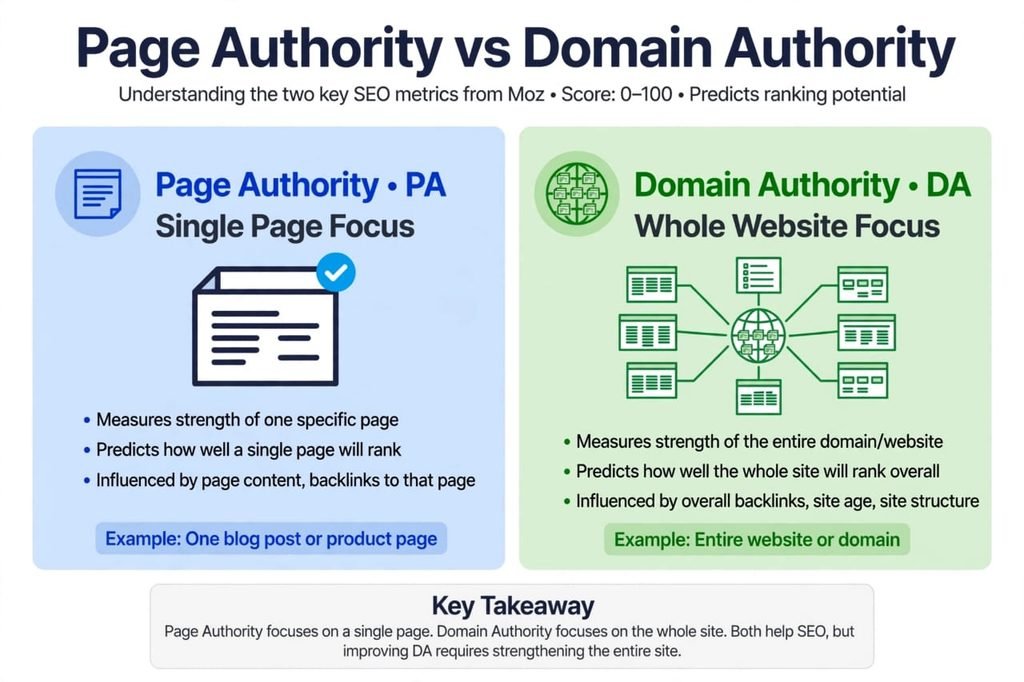
Table of Contents
What is Page Authority?
Page Authority, also known as PA, is a score that predicts how well a single page of your website will rank on Google.
For example, if you have 100 blog posts on your website, every single post will have its own different Page Authority score. One post can have a PA of 45, while another post on the same website can have a PA of only 12.
PA is calculated by looking at many factors related to that specific page, such as:
- How many quality backlinks are pointing to that one page
- How strong and relevant is the content on that page
- How many internal links are coming to that page from your other posts
- How old is that page and how often is it updated
In simple words, Page Authority answers this question: “How powerful is this ONE page?”
A high PA means Google trusts that specific page more than other similar pages on the internet.
What is Domain Authority?
Domain Authority, also known as DA, is a score that predicts how well your entire website or domain will rank on Google.
Unlike PA, DA does not look at one page. It looks at your whole website as one unit.
For example, if your website is example.com, then your DA score is for the whole example.com, not for a single blog post.
DA is calculated by looking at factors like:
- Total number of linking root domains to your website
- Overall quality and trust of your backlink profile
- Age and history of your domain
- Overall content quality and structure of your website
In simple words, Domain Authority answers this question: “How powerful is this WHOLE website?”
A high DA means Google sees your entire website as a trusted and authoritative source in your niche.
Page Authority vs Domain Authority: Key Differences Explained
To understand the difference clearly, let’s look at this simple comparison:
1. Scope:
Page Authority measures the strength of ONE page. Domain Authority measures the strength of the WHOLE domain.
2. Focus:
PA focuses on page-level backlinks and page-level content. DA focuses on domain-level backlinks and overall website trust.
3. Fluctuation:
PA can change very quickly. If one of your posts suddenly gets 10 good backlinks, its PA can jump in a few weeks. DA changes very slowly because it takes time to build trust for a whole website.
4. Use Case:
PA is best for checking which of your pages are performing well and which need more work. DA is best for comparing your website with your competitors’ websites.
Think of it like this: Your website is a school. Domain Authority is the reputation of the whole school. Page Authority is the performance of one single student in that school. A good school can still have a weak student, and a weak school can still have one top-performing student.
Page Authority vs Domain Authority: Which One Matters More for SEO?
This is the most asked question, and the honest answer is: Both matter, but for different reasons.
If you want to rank a specific blog post for a specific keyword, Page Authority matters more. Google ranks pages, not websites. When a user searches on Google, Google shows a page, not a homepage. So if your page has high PA, it has a better chance to rank, even if your overall DA is low.
But if you want to build a long-term, trusted brand, Domain Authority matters more. A website with high DA gets its new posts indexed faster, ranks faster, and gets more organic clicks even with less effort. High DA websites also get more natural backlinks because people trust them.
So, the smart strategy is not to choose one. You need to work on both.
New websites should first focus on PA. Create 10-15 high-quality posts and build strong internal linking and a few good backlinks to those posts. Once those pages start getting traffic, your DA will automatically start to improve.
Established websites should focus on maintaining DA while also improving PA for their most important money pages.
Pros and Cons of Page Authority
Pros of Page Authority:
- Easy to Improve: You can improve the PA of one page faster than the DA of a whole website. Just add a few quality backlinks and update the content.
- Perfect for Targeted Ranking: If you want to rank for one specific keyword, you can focus all your efforts on one page and increase its PA.
- Helps Find Weak Pages: PA helps you find which pages are weak and need more internal links or content updates.
- Great for New Websites: Even a new website with low DA can rank if one of its pages has high PA and great content.
Cons of Page Authority:
- Limited Impact: High PA of one page does not mean your whole website is strong. Your other pages can still be weak.
- Needs Constant Work: If you stop updating a page or it loses backlinks, its PA can drop quickly.
- Does Not Build Brand Trust: Users may trust one article, but they may not trust your whole brand just because of one good page.
Pros and Cons of Domain Authority
Pros of Domain Authority:
- Builds Long-Term Trust: A high DA website is seen as an authority in its niche. People trust it, and Google trusts it.
- Faster Ranking for New Posts: When your DA is high, your new blog posts rank faster because Google already trusts your domain.
- Better for Getting Backlinks: Other websites prefer to link to high DA websites. It becomes easier to get guest posts and collaborations.
- Competitive Advantage: You can easily outrank low DA competitors even if your content is similar.
Cons of Domain Authority:
- Takes a Long Time: Building DA takes months or even years. It cannot be increased overnight.
- Hard to Control: DA depends on many external factors like backlinks from other sites, which you cannot fully control.
- Can Be Misleading: DA is a third-party metric by Moz, not a Google ranking factor. Google does not use DA directly to rank websites. So a high DA does not always guarantee top ranking.
- Easy to Manipulate: Some people try to increase DA with spammy links. This can give a fake high DA for a short time but can harm the website in the long run.
How to Increase Page Authority?
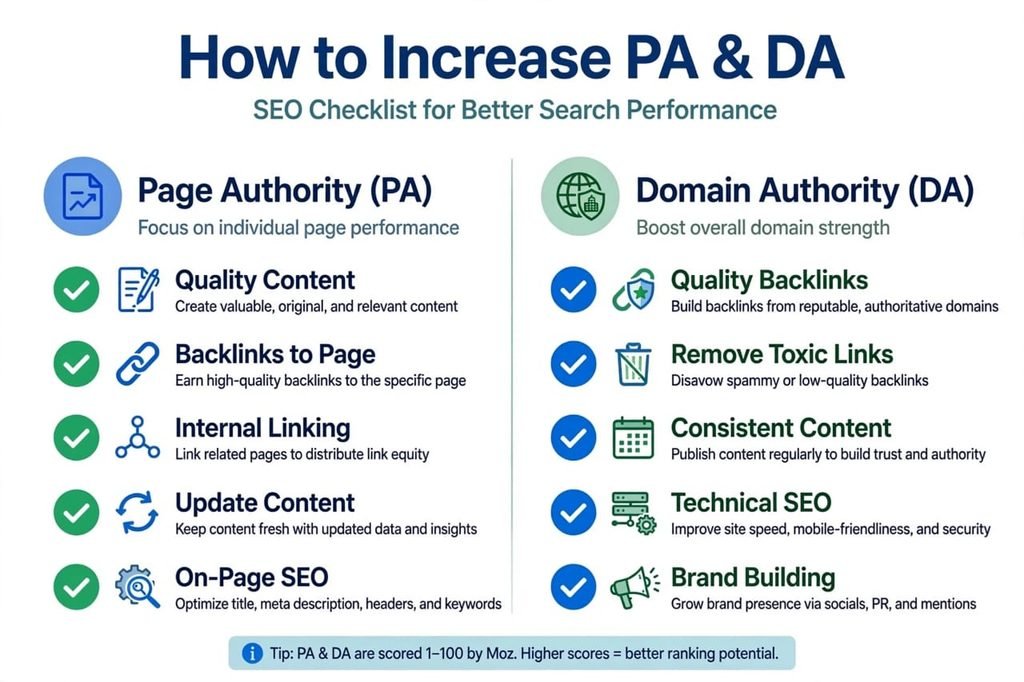
If you want to increase PA, follow these proven steps:
- Create High-Quality, In-Depth Content: Write content that fully answers the user’s question. Google loves detailed and helpful content.
- Build Quality Backlinks to That Specific Page: Instead of building links to your homepage, try to get backlinks to that specific blog post.
- Use Strong Internal Linking: Link to your important pages from your other high-traffic posts. This passes authority to that page.
- Update Your Content Regularly: Add new information, update old stats, and fix broken links. Fresh content keeps PA stable.
- Improve On-Page SEO: Use proper headings, meta title, meta description, image alt text, and fast loading speed.
How to Increase Domain Authority?
If you want to increase DA, you need a long-term strategy:
- Build High-Quality Backlinks: Focus on getting links from real, trusted, and relevant websites in your niche. One link from a high DA site is better than 100 links from low-quality sites.
- Remove Toxic and Spammy Links: Regularly check your backlink profile and disavow spammy links. Bad links can hurt your DA.
- Publish Content Consistently: A website that publishes helpful content regularly grows faster than a website that posts once in six months.
- Improve Technical SEO: Make sure your website is fast, mobile-friendly, secure (HTTPS), and has no technical errors.
- Build a Strong Brand: When people search for your brand name, share your content, and mention your website, your DA naturally increases.
Common Mistakes People Make About PA and DA
- Thinking DA is a Google Ranking Factor: Many beginners think Google uses DA. In reality, DA is made by Moz, not Google. Google has its own internal system. DA is just a good way to predict and compare.
- Buying Cheap Backlinks: Buying 1000 backlinks for $5 will not increase your real DA. It will destroy your website’s trust and can lead to a Google penalty.
- Checking Score Daily: PA and DA do not change daily. Checking them every day will only cause stress. Check them once a month.
- Ignoring Content Quality: No amount of backlinks can save poor content. Content is still the foundation.
Page Authority vs Domain Authority: Quick Comparison Table
Feature | Page Authority (PA) | Domain Authority (DA)
What It Measures | Strength of one single page | Strength of whole website
Score Range | 0 to 100 | 0 to 100
Created By | Moz | Moz
Changes | Fast | Slow
Best For | Ranking a specific post | Building overall brand trust
Impact | Page-level ranking | Domain-level trust
Which One Should You Focus On First?
If you are just starting a new website, focus on Page Authority first.
Pick 5 to 10 important keywords, create the best content for them, and build links to those pages. Once you get traffic and some good backlinks, your Domain Authority will start to grow on its own.
If you already have a website with good traffic, focus on both. Keep improving your top-performing pages to increase their PA, and at the same time, keep building your brand to increase your DA.
Remember, PA helps you win a single battle (ranking one keyword), while DA helps you win the whole war (building a trusted website).
Conclusion: Page Authority vs Domain Authority
Page Authority and Domain Authority are not competitors. They are two parts of the same SEO puzzle.
Page Authority tells you how strong one page is. Domain Authority tells you how strong your whole website is. You need both to succeed in SEO.
Instead of chasing only a high number, focus on creating helpful content, building real backlinks, and giving a great experience to your users. If you do that consistently, both your PA and DA will increase naturally over time.
So, stop worrying about which one is more important. Start working on both, and you will see real results.
Frequently Asked Questions
What is a good Page Authority score?
A PA score of 30 to 40 is considered good for a new website. A PA above 50 is very strong and can compete for competitive keywords.
What is a good Domain Authority score?
A DA of 20 to 30 is good for a new blog. A DA of 40 to 50 is strong, and a DA above 60 is excellent and very hard to achieve.
Can a page have high PA but the website has low DA?
Yes, this is very common. If one post goes viral and gets many backlinks, its PA can be high even if the overall website DA is still low.
Is Domain Authority a Google ranking factor?
No, DA is not a direct Google ranking factor. It is a metric by Moz to predict ranking ability. Google does not use Moz’s DA score.
How often should I check my PA and DA?
You should check them once a month. They do not change quickly, so daily checking is a waste of time.
Which tool is best to check PA and DA?
You can use Moz Link Explorer, Ahrefs, Semrush, or any free PA DA checker tool to check your scores quickly.
Pingback: Most Accurate Website Value Calculator - 5 Tools (2026)