Page Authority is one of the most important SEO metrics for any website owner, blogger, or digital marketer. If you want your individual blog posts and landing pages to rank on Google, you need to understand what Page Authority is and how it works.
In this complete guide, we will explain what Page Authority (PA) means, how it is calculated, what is a good Page Authority score, the difference between Page Authority and Domain Authority, and 9 proven ways to increase your Page Authority fast in 2026.
You can also check your score instantly with our free Page Authority Checker Tool.
What is Page Authority (PA)
Page Authority (PA) is a score developed by Moz that predicts how well a specific page on your website will rank on search engine result pages (SERPs).
The score ranges from 1 to 100. A higher score means a higher ability to rank. For example, a page with a PA of 70 has a much better chance of ranking on the first page of Google than a page with a PA of 20.
It is important to understand that Page Authority is not a Google ranking factor. Google does not use Moz’s PA score directly. However, PA is based on many of the same factors that Google uses, such as high-quality backlinks, content quality, and link profile strength. Because of this, it is a very useful comparative metric to measure the strength of a single page against competing pages.
While Domain Authority (DA) measures the strength of your entire domain, Page Authority measures the strength of just one page. For example, your homepage may have a PA of 45, but a new blog post may have a PA of only 1. This is completely normal.
If you want to understand the full domain-level metric, read our guide on What is Domain Authority and How to Increase it?
Page Authority Definition in Simple Words
In simple words, Page Authority tells you: How powerful is this one page?
Think of it like this. Your website is a school. Domain Authority is the reputation of the whole school. Page Authority is the reputation of one single student in that school. One student can be very famous even if the school is new, and vice versa.
That is why many new websites can still rank for specific keywords. Even if their Domain Authority is low, if they create one excellent page with strong backlinks, that page can get a high Page Authority and outrank older websites.
How is Page Authority Calculated?
Page Authority is calculated using a machine learning model that uses more than 40 different factors. Moz’s algorithm looks at data from its Link Index and correlates it with actual rankings from thousands of search results.
The main factors that influence Page Authority are:
1. Number of Linking Root Domains: How many unique websites link to this specific page? More unique domains mean higher PA.
2. Total Number of Backlinks: The total quantity of external links pointing to the page.
3. Quality and Authority of Linking Pages: A link from a high-authority website like Forbes or Wikipedia is much more powerful than 100 links from low-quality spam sites.
4. Relevance of Links: Links from websites in the same niche or topic are more valuable than random links.
5. MozRank and MozTrust: MozRank measures link popularity, while MozTrust measures how trustworthy the linking sites are. Pages linked by trusted sites get higher PA.
6. Content Quality and On-Page SEO: Well-optimized content, proper headings, internal linking, and user engagement signals indirectly support PA growth.
Page Authority uses a logarithmic scale. This means it is much easier to increase your score from 10 to 20 than it is to increase it from 70 to 80. Going from 80 to 90 requires a massive amount of high-quality links and authority.
Because of this logarithmic nature, you should focus on consistent improvement rather than expecting overnight jumps.
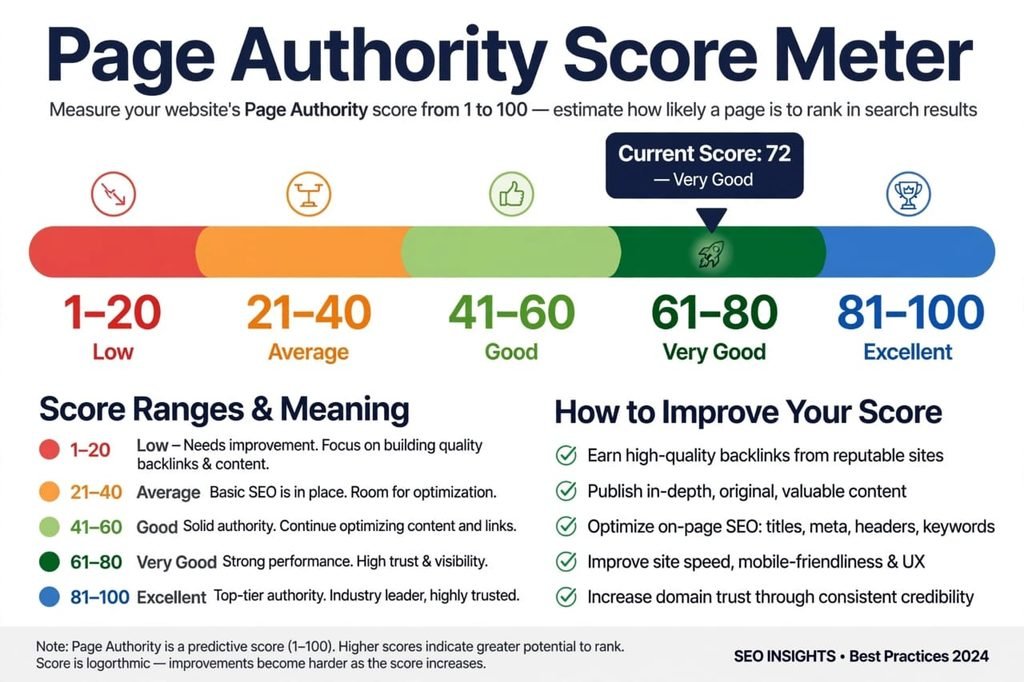
What is a Good Page Authority Score?
There is no fixed “good” score that works for everyone. A good Page Authority score depends on your niche and your competitors.
Here is a general guide to understand your PA score:
PA 1 – 20: Very Low. This is common for new pages and new websites. You need to start building backlinks and improving content.
PA 21 – 40: Average. Most small blogs and business websites fall in this range. With consistent effort, you can start ranking for low-competition keywords.
PA 41 – 60: Good. Your page is competitive. You can rank for medium-competition keywords and get good organic traffic.
PA 61 – 80: Very Good. Your page is authoritative in its niche. You can compete with large websites.
PA 81 – 100: Excellent. Only very powerful pages like Wikipedia, YouTube, and major news sites reach this level.
Instead of chasing a perfect 100, the best strategy is to compare your page with the top 10 pages already ranking for your target keyword. If the top-ranking pages have a PA of 35, you need a PA of 38-40 to compete. If they have a PA of 60, you will need a stronger link-building strategy.
You can check your current score in seconds using our free PA Checker Tool. Just enter your page URL and get your PA, DA, and Spam Score instantly.
Can a Page Have High PA and Low DA?
Yes, absolutely. This happens very often. A new website can publish one viral article that gets hundreds of backlinks. That one page will have a very high PA, even though the website’s DA is still low.
This is great news for new bloggers. You do not need to wait years to build Domain Authority. You can focus on building Page Authority for your most important articles and start getting traffic faster.
Which is More Important: PA or DA
Both are important, but for ranking a specific keyword, Page Authority is more important. Google ranks pages, not websites. When a user
searches for a query, Google shows the best page for that query, not the best website.
However, Domain Authority helps all your pages. A website with high DA will find it easier to increase PA for new pages because the whole domain is trusted.
The best SEO strategy is to work on both at the same time: build DA for your website, and build PA for your money pages.
How to Check Page Authority
Checking your Page Authority is very simple and takes less than 10 seconds.
Step 1: Go to our free Domain Authority and Page Authority Checker
Step 2: Enter the full URL of the page you want to check. For example: https://example.com/best-seo-tips
Step 3: Click on Check.
Step 4: You will instantly see your Page Authority, Domain Authority, MozRank, and Spam Score.
You should check your PA once a month. Track your progress in a spreadsheet. If your PA is increasing, your SEO strategy is working. If it is decreasing, you may have lost backlinks or your competitors have become stronger.
How to Increase Page Authority Fast in 2026
Now comes the most important part: how to actually increase your Page Authority. Here are 9 proven methods that work in 2026.
1. Create High-Quality, Link-Worthy Content
Content is the foundation of Page Authority. No one will link to thin, copied, or low-value content.
Create in-depth, original content that solves a real problem. Articles with 1500+ words, original research, case studies, infographics, and step-by-step tutorials get 3x more backlinks than short posts.
Make your content the best resource on that topic on the internet. When your content is the best, other websites will naturally link to it.
2. Build High-Quality Backlinks to That Specific Page
This is the number one factor for PA. You need backlinks pointing directly to the page you want to boost, not just to your homepage.
Ways to get backlinks:
Write guest posts on reputable blogs in your niche and link back to your page
Create shareable infographics and data studies
Do HARO / journalist outreach and get quoted
Find broken links on other sites and suggest your page as a replacement
Share your content in relevant communities and forums
Focus on quality, not quantity. One link from a DA 80 website is better than 50 links from DA 10 spam sites.
Improve Your Internal Linking
Internal linking is the fastest and easiest way to increase PA. Link from your high-PA pages to your low-PA pages.
For example, if your homepage has a PA of 45, add a link from your homepage to your new blog post. This passes link juice and authority to the new page.
Also, link related articles together. If you have an article about Domain Authority, link it to your Page Authority article, and vice versa. This helps Google understand your site structure and distributes authority evenly.
Use descriptive anchor text. Instead of “click here”, use “what is Page Authority”.
4. Remove Toxic and Spammy Backlinks
Bad links can hurt your PA and increase your Spam Score. If you have links from spammy, adult, gambling, or irrelevant sites, they can drag your page down.
Use Google Search Console and Moz to find toxic links. Contact the website owners to remove them, or use Google’s Disavow Tool as a last resort.
A clean link profile is more powerful than a large but spammy one.
Optimize On-Page SEO
On-page SEO does not directly increase PA, but it helps your page get more traffic, engagement, and natural links, which indirectly boosts PA.
Use your main keyword in the title, first 100 words, and H1, H2 headings
Write a compelling meta description to improve click-through rate
Use short, clean URLs with your keyword
Add images with proper alt text
Improve page loading speed to under 2 seconds
Make your page mobile-friendly
A well-optimized page gets more shares, more time on page, and lower bounce rate, all of which signal quality to Google.
6. Update Old Content Regularly
Google loves fresh content. A page that was published in 2022 and never updated will slowly lose its authority.
Update your old articles every 6 months. Add new information, new statistics for 2026, new images, and fix broken links. When you update a page, republish it with a new date.
This tells Google that your content is still relevant, and it often results in a ranking boost and more backlinks.
Promote Your Page on Social Media and Email
Promotion does not directly increase PA, but it increases visibility. The more people see your page, the more chances someone will link to it.
Share your article on X (Twitter), LinkedIn, Facebook, Pinterest, and in relevant Reddit communities. Send it to your email list. If your content is genuinely helpful, promotion will lead to natural backlinks.
8. Fix Technical SEO Issues
Technical errors can prevent your page from getting its full PA potential.
Fix 404 errors and broken links
Make sure your page is indexed and not blocked by robots.txt
Use HTTPS (SSL certificate)
Fix duplicate content issues
Improve Core Web Vitals: LCP, CLS, INP
Use Google Search Console to find and fix these issues quickly.
9. Be Patient and Consistent
Page Authority does not increase overnight. Moz updates its index every 3-4 weeks. It can take 2 to 6 months to see a significant increase.
Do not buy cheap backlinks or use black-hat SEO tricks. These may give a short-term boost, but they will eventually get your site penalized and your PA will drop.
Focus on consistent, white-hat SEO. Publish one high-quality article per week, build 2-3 quality links per month, and your PA will grow steadily.

Frequently Asked Questions (FAQs)
What is Page Authority in SEO?
Page Authority is a Moz metric from 1 to 100 that predicts how well a specific web page will rank in search results. Higher PA means a higher chance of ranking.
What is Page Authority vs Domain Authority? PA and DA Difference Explained
PA measures the strength of a single page, while DA measures the strength of the entire website domain. PA is for one URL, DA is for the whole site.
What is Page Authority and How Long Does It Take to Increase It?
It usually takes 2 to 6 months to see a noticeable increase. It depends on your link-building speed, content quality, and competition. High-quality backlinks can speed up the process.
Is Page Authority a Google Ranking Factor? What is Page Authority in SEO?
No, Page Authority is not used by Google. It is a third-party metric by Moz. However, it is based on similar factors that Google uses, so it correlates strongly with higher rankings.
What is a good Page Authority for a new website?
For a new website, a PA of 20-30 is a good starting goal. Once you reach 30+, you can start ranking for low to medium competition keywords. Focus on beating your competitors, not reaching 100.
Can I check Page Authority for free?
Yes, you can use our free Page Authority Checker to check PA, DA, and Spam Score for any website in seconds, without signing up.
Conclusion
Page Authority is a powerful metric to understand how strong a single page is. It helps you know where you stand against competitors and what you need to do to outrank them.
To summarize: Create great content, build high-quality backlinks to that specific page, use smart internal linking, remove toxic links, and be patient. If you follow these steps consistently, your Page Authority will increase in 2026 and beyond.
Do not wait. Check your score now with our free tool and start improving your most important pages today.
[Check Your Page Authority Now – Free Tool]
Pingback: What is Domain Authority? Complete Guide 2026