Are you worried why your website is not ranking on Google even after writing good content? The answer is often hidden in one powerful metric called Domain Authority.
In this complete guide, you will learn what is Domain Authority, how it is calculated, what is a good DA score in 2026. Whether you are a blogger, a business owner, or an SEO beginner, this article will give you a clear roadmap.
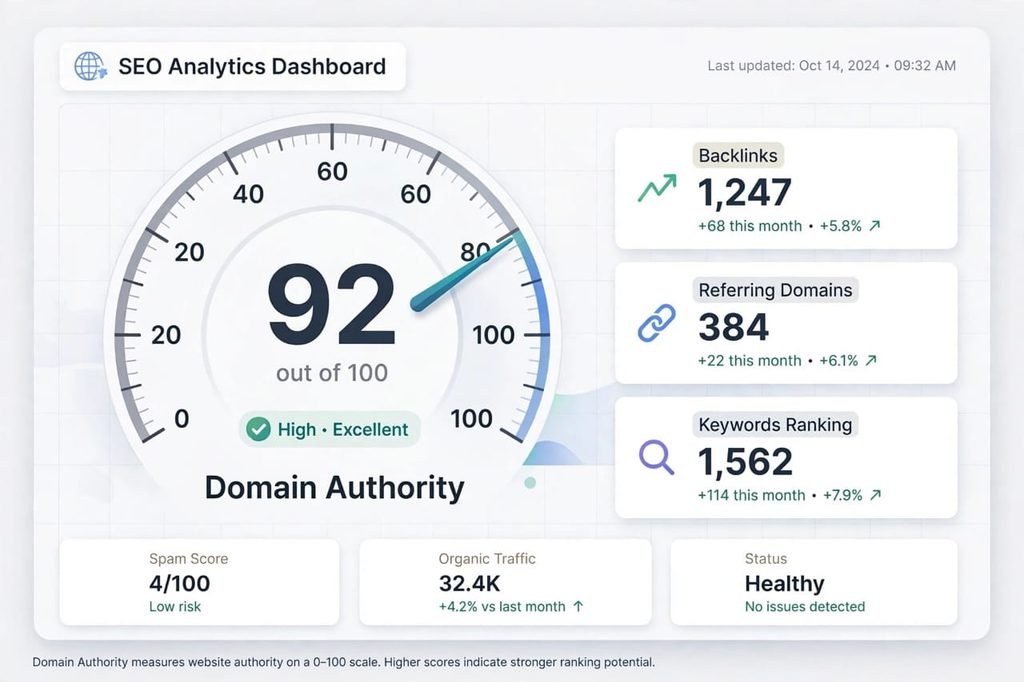
Table of Contents
What is Domain Authority?
Domain Authority, also known as DA, is a search engine ranking score developed by Moz. It predicts how likely a website is to rank in search engine result pages, also known as SERPs.
The score ranges from 1 to 100. A higher score means a greater ability to rank. A website with a DA of 80 is much stronger than a website with a DA of 20.
For example, websites like Google, Wikipedia, and YouTube have a Domain Authority of 90+. A new blog will usually start with a DA of 1. This does not mean your website is bad. It simply means you have to build your authority over time.
Domain Authority is not a Google ranking factor. Google does not use Moz DA directly. However, it is still a very useful metric to compare your website with your competitors and to measure the strength of your SEO efforts.
Why is Domain Authority Important?
Domain Authority is important for three main reasons:
1. It Helps You Compare With Competitors
If your competitor has a DA of 45 and you have a DA of 25, you know you need to work harder on backlinks and content. It gives you a clear benchmark.
2. It Shows Your Website Strength
A high DA shows that your website is trusted. Search engines, advertisers, and guest bloggers all prefer high DA websites.
3. It Helps You Get Backlinks
When you do outreach for guest posts or link building, website owners check your DA first. A higher DA increases your chances of getting a high-quality backlink.
How is Domain Authority Calculated?
Moz calculates Domain Authority using more than 40 different factors. The most important factors are:
1. Linking Root Domains
This is the total number of unique websites linking to your website. If 100 different websites link to you, it is much better than 100 links from only one website.
2. Total Number of Backlinks
The total number of external links pointing to your site also matters. But quality is always more important than quantity.
3. Quality of Links
A link from a high authority website like Forbes or HubSpot is worth more than 100 links from low-quality spam websites.
4. Spam Score
If your website has too many spammy links, your DA will go down. Moz also checks your spam score.
5. Age and Trust of Domain
Older domains with consistent good content usually have higher DA.
Moz uses a machine-learning model to calculate DA. It constantly updates its algorithm, so your DA score can go up and down even if you do nothing. This is called a DA update.
What is a Good Domain Authority Score?
Many beginners ask what is a good DA score. The truth is, there is no fixed number. It depends on your niche.
Here is a simple scale to understand:
DA 1 to 20: New or small website. This is normal for beginners.
DA 20 to 40: Average website. You are growing and getting some traffic.
DA 40 to 60: Strong website. You can compete for medium competition keywords.
DA 60 to 80: Very strong website. You are an authority in your niche.
DA 80 to 100: Top websites in the world. Very difficult to reach.
Instead of chasing a score of 100, you should focus on having a higher DA than your direct competitors. If all your competitors have DA 30, then DA 35 is excellent for you.
Domain Authority vs Page Authority
Many people confuse Domain Authority with Page Authority.
Domain Authority (DA) measures the strength of the entire domain or website.
Page Authority (PA) measures the strength of a single page or URL.
For example, your homepage may have a PA of 40, but your new blog post may have a PA of only 10. As you build links to that specific post, its PA will increase.
Both metrics are important, but for overall website growth, you should focus on DA first.
Domain Authority vs Domain Rating
Domain Rating, or DR, is a similar metric by Ahrefs. Domain Authority is by Moz.
Both work on a 1 to 100 scale and both measure link strength. The numbers may be different because they use different databases, but the concept is the same. You do not need to worry about both. Pick one tool and track it consistently.
How to Check Domain Authority of Any Website?
You can check DA for free using these tools:
1. Moz Link Explorer
Go to Moz.com, create a free account, and enter any domain. It will show DA, PA, backlinks, and spam score.
2. MozBar Chrome Extension
Install MozBar in your Chrome browser. When you visit any website, it will show its DA and PA in the top bar. This is the fastest way.
3. Small SEO Tools DA Checker
Many free websites allow you to check DA in bulk. Just search “Domain Authority Checker” on Google.
Pro Tip: Check your DA only once a month. Checking it daily will not help because DA updates slowly.

How to Increase Domain Authority in 2026? 7 Proven Methods
Now comes the most important part. How can you increase your Domain Authority fast? Here are 7 proven strategies that work in 2026.
1. Create High-Quality, Long-Form Content
Google and Moz both love in-depth content. Write articles that are 1500+ words, well-researched, and solve a real problem.
A 1500-word guide with images, examples, and clear headings will get more backlinks naturally than a 300-word short post. Always aim for quality over quantity.
2. Build High-Quality Backlinks
Backlinks are the backbone of Domain Authority. Without backlinks, your DA will never increase.
Best ways to get backlinks in 2026:
- Write guest posts on relevant blogs in your niche
- Create infographics and share them
- Do HARO outreach and answer journalist questions
- Find broken links on other sites and suggest your content as a replacement
- Create original research, statistics, and case studies
Remember, one link from a DA 70 site is better than 50 links from DA 10 sites.
3. Remove Bad and Spammy Links
If you have toxic backlinks from spammy or porn or gambling websites, they can hurt your DA.
Use Google Search Console or Moz to find these bad links. Then use Google Disavow Tool to disavow them. This tells Google to ignore those links.
Clean link profile = Higher trust = Higher DA.
4. Improve Internal Linking
Internal linking means linking your own articles to each other. For example, if you write about Domain Authority, link to your article about Page Authority.
This helps Google understand your website structure and passes authority from one page to another. It also keeps visitors on your site for longer, which is a positive signal.
5. Make Your Website Technically Strong
A slow or broken website will never get high DA.
- Make your website load in less than 3 seconds
- Make it mobile-friendly
- Use HTTPS (SSL Certificate)
- Fix all 404 errors and broken links
- Create a proper XML sitemap
A technically strong website is easy for Google to crawl and easy for users to use.
6. Be Active on Social Media
Social signals do not directly increase DA, but they help indirectly. When you share your content on Facebook, X, LinkedIn, and Pinterest, more people see it. More people seeing it means more chances of getting natural backlinks.
7. Be Patient and Consistent
Domain Authority does not increase overnight. It usually takes 3 to 6 months of consistent work to see a big jump.
Many bloggers give up after 1 month. Do not make that mistake. Publish one high-quality article every week, build 2-3 good backlinks every month, and your DA will grow steadily.
Common Myths About Domain Authority
Myth 1: DA is a Google Ranking Factor
False. Google has confirmed it does not use Moz DA. But websites with high DA often rank well because they have strong backlinks, which Google does love.
Myth 2: You Can Buy DA
Some websites sell “Increase DA” services. They use spammy links. Your DA may go up for a short time, but Google will penalize you later. Never buy DA.
Myth 3: DA 100 is Possible for Everyone
No. It is almost impossible for a normal blog to reach 90+. Focus on beating your competitors, not reaching 100.
Domain Authority Update: What Changed in 2026?
In recent updates, Moz has improved its DA calculation to better detect spam and AI-generated low-quality content.
Now, websites with thin AI content without value are losing DA. Websites with original, helpful, and human-written content are gaining DA.
This means in 2026, you must focus on E-E-A-T: Experience, Expertise, Authoritativeness, and Trustworthiness. Write from real experience, not just copy-paste.
Final Verdict: Should You Focus on Domain Authority?
Yes, but do not obsess over the number. Domain Authority is a guide, not a goal.
Your real goal should be to create helpful content and earn real backlinks. If you do that, your Domain Authority will automatically increase.
Start today. Check your current DA, compare it with your top 3 competitors, and make a 6-month plan to beat them.
If you found this guide helpful, share it with other bloggers and bookmark this page for future reference.
Frequently Asked Questions (FAQs)
What is Domain Authority in simple words?
Domain Authority is a score from 1 to 100 that predicts how well a website will rank on Google. Higher is better.
How long does it take to increase Domain Authority?
Usually 3 to 6 months with consistent content and link building.
Is Domain Authority free to check?
Yes, you can check it for free using Moz Link Explorer and MozBar.
Can a new website have high DA?
No, new websites start with DA 1. It grows with time, content, and backlinks.
What is the difference between DA and PA?
DA is for the whole website, PA is for a single page.
Pingback: How to Check Domain Authority for Free (2026)
Pingback: How to Build Internal Links to My Website: Best Guide 2026